November 18th, 2023. Snass Session: Francois Shilpahan Tappen 1909.
Snass Sessions 11.18.2023: François Shilpahan, Tappen Siding, 19091
David Douglas Robertson, PhD
Consulting linguist, Spokane, WA, USA
Background information on this writer:
We know quite a lot about Shilpahan. His is a Salish name. It’s perhaps from Shuswap s- ‘nominalizer’ (Kuipers 1974:41) + lep’ ‘to bend down (esp. branches)’ p.201 + -ex̌n ‘armpit, wing’ (p.68). It’s spelled Selpaghen in Carlson 2001:178. Chief François Shilpahan wrote letters [089] (datelined Quaaout), [123], [141], [144], [146] (all datelined Tappen / Tappen Siding), and [139] (datelined Shhkaltkmah (?)), and is mentioned in [021.001]. This chief’s supervision of the construction of Saints Peter and Paul church at Little Shuswap in 1910 is detailed in Ellaschuk (1990).
Kamloops Wawa connections: François Shilpahan of Shuswap subscribes (#24, 1 May 1892), is associated with Quaaout, married Eugénie Jules of Shkaltkmah while at Sugarcane (#62, 22 January 1893), he reports that chief Damien of Quaaout is dead (#77, 7 May 1893), is unanimously elected new chief there (#89, 30 July 1893), is proselyte / watchman of the eucharist there (#112, January 1894), is in photo of Shuswap Indians (#124, January 1895), is greeted in Chinuk pipa letter from Belgium (#138, March 1896), is having his people cut timber to trade for lumber for new church (#140 May 1896), has won a prize in a shorthand competition (#159, December 1897), is associated with Tappen [Siding] when we hear of his excursion around the Kootenays (#208, March 1904; #210, June 1904), is noted in Le Jeune’s stay at ‘Shilpahan’s Chapel’ (#’2′, April 1918).
Tappen / Tappen Siding, BC is a railway-associated settlement on the shores of Shuswap Lake in eastern Secwépemc (“Shuswap”) Salish land in south-central British Columbia.
There’s usually little or no punctuation in the Indigenous-written letters, so what you see here is pretty much my additions of commas, periods, and so on.
If you see [SIC] in square brackets it shows possible mistakes in the writing; other material [in square brackets] is inferred and added by me.
*Asterisked* material shows an uncertain reading of the Chinuk Pipa writing.
Underlined material is in other languages than Chinook Jargon.
Anything < in angled brackets > is non-Chinuk Pipa, i.e. written as standard English in the original document.
The notation (Ø) shows that you can understand a clause to contain either “silent IT”or a “silent preposition”.
I have put line breaks between every clause-containing sentence, and added punctuation, to help the reader. (But I’ve preserved each writer’s own idiosyncratic punctuation marks.) I’m sometimes experimenting with extra indentation to show the existence of subordinate clauses. (And to reflect the flow of the speaker’s thoughts.)
Many thanks to all of you who participated in this Snass Session!
IN THE TRANSLATION OF THIS DOCUMENT, IF I’VE PUT IN A LINE IN ITALICS, IT’S TO SHOW THE LITERAL MEANING OF EACH “WORD”.
The Letter
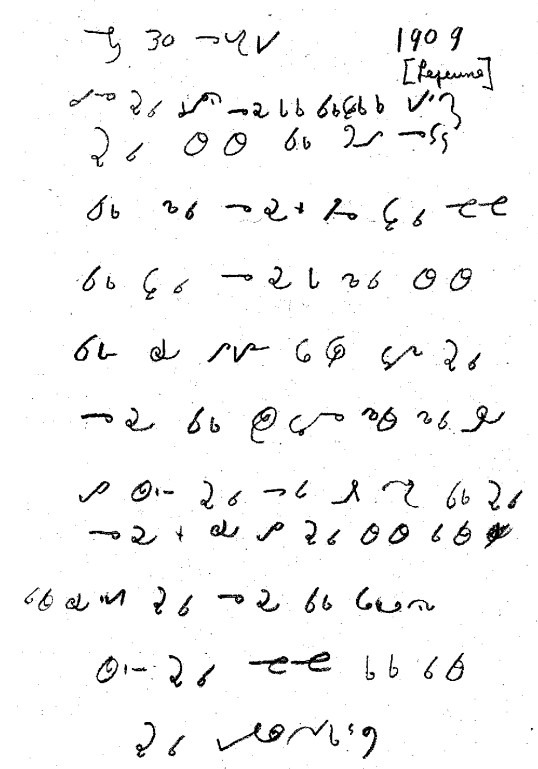
The letter, transcribed & with a suggested translation:
Tapin < 30 > Disimbir < 1909 > Tappen 30 December 1909‘Tappen, 30th of December 1909.’
Alta naika patlach2 tanas-pipa kopa maika papa Pir Lshyun now I give little-writing to you father Père Le Jeune‘Now I’m giving a note to you, father Père Le Jeune.’
Naika wawa kopa Andri Damiin3 I say to Andre(w) Damien‘I said to Andre(w) Damien’
kopa iaka tanas4 < + > Ikta maika tomtom5 about his kid what your heart ‘about his kid + What are your thoughts’
kopa maika tanas Pi iaka wawa to your kid and he say‘about your kid? And he said’
Kopit pus6 liplit mamuk-mirii7 naika only if priest make-married my ‘Only if the priest marries my’
2
Lots of Chinuk Pipa writers say patlach ‘give’ a letter instead of ‘send’, which would be mash. 3
Damiin is the baptismal name ‘Damien’. It’s written here according to the English pronunciation. The French pronunciation, with the usual Jargon change of nasal vowels to plain vowels, would be Damia. I’ll point out a couple of examples of that later in the letter. We often find both the English & French ways of saying a name in BC Chinook Jargon.4
As we read through this letter together, we found it necessary to be reminded that tanas neutrally means ‘child’. It contains no clues about gender…5
Reminding you of one of an Indigenous metaphor that Chinook Jargon uses every day – someone’s feelings and thoughts are referred to as their tomtom ‘heart’. So, “What do you think about her?” is ikta maika tomtom kopa iaka, ‘What is your heart to/for her?’ 6
Kopit pus… always means ‘only if’ such-and-such happens. Learn this 2-word idiom. (But if there were no pus ‘if’ here, the kopit could have its other meaning, ‘finished, done doing’, etc. Do you see why?) 7
Mirii is a bit less common spelling for the Jargon word that means ‘married’. It implies a more French-influenced pronunciation like meriyé. The mamuk- prefix gives a sense of ‘make-’, so mamuk-mirii is ‘to make (someone) be married’, the way a priest does by performing a wedding.
3
tanas kopa Wiam Marta8 ia(k)wa*9 iaka10 tlus kid to William Martin then (s)he good‘kid to William Martin, then they’ll be all right.’
Ilo wiht11 naika tiki tlap-shim12 kopa naika no more I want catch-shame from my‘No more do I want to get embarrassed by my’
tanas < + > Pus ilo naika wawa kakwa13 kid if not I say this.way‘kid + If I didn’t say this’
8
Wiam shows that Native speakers of Jargon heard local Settlers pronouncing ‘William’ without the “L” sound, still a frequent informal way of talking English. Marta is evidently ‘Martin’, a French baptismal name, with that usual Jargon denasalization at the end. By the way, now we can infer that Damien’s kid is female, right? 9
Ia(k)wa* is marked with an asterisk to show some uncertainty in reading it. It appears Shilpahan absent-mindedly wrote iakwa ‘here’ when he meant iawa ‘then; there’. Our participant Carl points out that in today’s document, several occurrences of the letter wa (the big circle with a little circle inside) similarly start with what looks like a straight down-slanting line, which would be the Chinuk Pipa letter “k”. Shilpahan definitely has a couple of other tiny “mistakes” in today’s note, as you can see in line 2’s maika (he wrote only mai at first, then had to go back and cram in a tiny ka), and in the crossed-out word in line 9. 10
Iaka tlus might be expected to mean ‘it’ll be okay’, except that iaka normally is limited to living beings! So iaka refers to Andre(w) Damien’s tanas, his ‘kid’. We still don’t know the kid’s gender yet at this point in the note, so I translated iaka as ‘they’. 11
Ilo wiht is a common 2-word idiom, ‘no more’. Know it! As is the strong tendency with all Jargon expressions of quantity (think about that), ilo wiht here comes first in the sentence. 12
Tlap-shim is made of 2 parts. The prefix tlap- always signals something happening without being controlled by the person who’s the subject of the verb. Also, it typically indicates a “change of state”, to ‘become / get’ a certain way. And, typical for Jargon’s Indigenous nature, shim is a verb, ‘to be ashamed’. (Even though it comes from an English noun!) Together, then, tlap-shim = ‘to be ashamed, to wind up becoming shamed, to get embarrassed’. Thanks to our participant Paisley for the excellent translation into real people’s English, ‘embarrassed’. 13
Wawa kakwa is a common 2-word idiom, ‘to say this’ / ‘to say that’. Learn it! Literally, it’s ‘to say thus; to talk like that’, but neither of those is how we’d actually talk English these days.
4
(Ø) kakwa-pus14 hilp15 naika tanas kopa masachi16 it be.like-if help my kid in bad.thing‘it’d seem like helping my kid in some bad stuff’
Wiht naika tomtom, papa, kakwa17 also my heart father be.like.that‘My feelings too, father, are like that’
Naika Fraswa18 Shilpaxan19 I François Shilpahan‘I’m François Shilpahan’
14
Kakwa-pus is an extremely important 2-word idiom, ‘seems (like)’. Learn it! 15
Kakwa-pus hilp, literally ‘as if helping’, is conceptually about naika (‘I, Andrew Damien’) doing the helping. But it doesn’t have naika in it, does it? What it has instead is “silent IT” for the subject. So it’s really saying silent IT ‘it’ kakwa-pus ‘is as if; seems like’ hilp ‘helping’. These kinds of small clauses, as linguists might call them, are rather common in real folks’ Chinuk Wawa. 16
Masachi ‘bad’ is very often a noun, so then it means ‘bad stuff; bad thing(s); bad actions’. The word tlus ‘good’ and a couple other adjectives also get used as vague nouns like this. All the way back to the Jargon dictionaries of 150 years ago, it’s been emphasized that there’s more than one word for ‘bad’. Here are a few of the common ones:
Masachi always implies being ‘mean; evil; nasty; violent; low-down’, more or less on purpose, and having negative effects on other people.
The near-synonym kaltash always has a different feel to it, ‘useless, worthless, no-good, casual, ineffective, in vain’, usually by nature (not by choice), and typically harming – and helping – nobody else.
There’s also the Northern Dialect use of piltin as ‘sinful’; that word just means ‘crazy’ in the Southern Dialect. (So Northern speakers will say krisi for ‘crazy’.)
Because Jargon likes to make so many shades of negative evaluation, it’s also important to know the 2-word phrase wik-tlus, literally ‘not-good’, which is just neutrally ‘bad’ for talking about things instead of humans.
17
Wiht naika tomtom, papa, kakwa: ‘Also my heart, father, is like that.’ It’s uncommon but okay for a speaker to sort of interrupt what they’re saying to address the hearer like this. 18
Fraswa is another example of the Jargon de-nasalizing a French vowel; compare the French spelling François.19
Shilpaxan is written with the somewhat rare lightning-bolt shaped letter for the “back X” sound. (The uvular fricative, in linguist talk.) Like the Chinuk Pipa letter h, which is a dot, this x doesn’t connect to any letters around it. Judge for yourself whether the writer is using the x letter in other places where it might be expected, like the word wiht in lines 8 & 11.
5